Tuesday, 12 February 2013

The Hour Has Passed

I do not know what it is about you that closes
and opens; only something in me understands
the voice of your eyes is deeper than all roses
nobody, not even the rain, has such small hands
The Hour has been axed by BBC2 and will not return for a planned third series, it's been confirmed. The period drama, which was set in the late 1950s and concerned the genesis of a fictional current affairs programme on BBC Television, was created by Abi Morgan and starred The Wire's Dominic West, Skyfall's Ben Whishaw and The Crimson Petal and the White's Romola Garai. It had been the original intention of the production company behind the programme, Kudos, to produce at least three series. Jane Featherstone, chief executive of Kudos Film and Television, said she was "sad and disappointed" by the decision. Speaking in November, Morgan admitted that she would relish the chance to continue the story. "I love those characters and I'm really excited to create more characters, so fundamentally I'd love to see it develop and grow." Garai - who played Bel Rowley - also declared that she would be interested in starring in more episodes. "I don't think the format of this show lends itself to running for 10 or 15 years, but hopefully we'll do some more," said the actress.

In its two years on air, The Hour received four Golden Globes nominations, having been shown on BBC America, and three Bafta nominations. In 2011 it was named as one of the 20 best shows of the year by Radio Times critics and launched with 2.89 million viewers. Yet in comparison with another of the BBC's period dramas, Call The Midwife (which, unsurprisingly, will be receiving a third series), series two, which aired in November and December 2012, saw the show struggle to attract large numbers of viewers, with fewer than 1.5m tuning in.


In the spirit of felling tall oaks to let little acorns flourish, the news comes in the wake of the BBC drama department previewing a raft of new projects, including a Liz Taylor/Richard Burton biopic that's intended as BBC Four's drama swan song (the channel will be all factual, all the time in future), starring Dominic West as the Burton to Helena Bonham-Carter's Taylor. There is also the six-part adaptation of Susanna Clarke's Jonathan Strange & Mr Norrell, the recently announced fantasy series Atlantis, and BBC Three zombie comedy series In The Flesh. A BBC spokesperson said: "We loved the show but have to make hard choices to bring new shows through."
Read more on this article...

Why Sex Is Subordinate To Violence

"I believe in the radical possibilities of pleasure..."
Why is it so hard to get sex right in pop culture? asks Think Progress' Alyssa Rosenberg. On Friday, Showtime announced that it had picked up a new show called The Affair, which would tell the stories of a relationship that interrupts two marriages, splitting up the episodes to explore the perspectives of the men and women involved separately. It was a decision that, along with the forthcoming Masters of Sex, a historical drama bout the sex researchers Masters and Johnson, and Ray Donovan, which follows a Los Angeles fixer who is also dealing with the consequences of childhood sexual abuse in his family, that furthered a brand that underlies a great deal of Showtime’s work, and that makes the network unusual among its peers. Showtime increasingly as interested in exploring sex as it is violence.

This isn’t to say that all of Showtime’s programming is solely preoccupied with sex, but three of its foundational shows, The L Word, about affluent lesbians, Queer As Folk, an adaptation of the British drama, and Soul Food, an adaptation of the movie, were all substantially concerned with how adults approach sex, sometimes in the context of their families. It’s a theme that continues in the shows that are airing on it presently. Shameless is substantially about the sexual relationships of multiple generations of the Gallagher family. House of Lies examines both the sex lives of successful consultants and the sexual and gender identity of the main character’s son. Californication‘s focus is announced in its title. Dexter is a serial killer show that’s frequently explored the sexual components of violence. And Homeland started out as a show about national security and has morphed into an epic romance grounded in a striking sexual connection between its two main characters, a dogged CIA agent and the undercover terrorist she is pursuing.


"We have the ability to be adults, try to use the lack of restrictions that we have because we don’t sell to advertisers, use it to most interesting effect. And there are
taboo subjects that we can explore that other people don’t have — other programmers don’t have the same freedom and ability," explains Showtime president David Nevins, when asked about that trend at the Television Critics Association press tour in January, and about how intentional the network’s focus on sex was. "Masters of Sex feels like a show that only we could get away with, that only pay cable could get away with… Sex is one of the places where we can distinguish ourselves. But it’s really important to me also that we be interesting and provocative in a deeper way, not just salacious."

That’s an ambitious goal to set, says Rosenberg, and one she is particularly curious to measure The Affair, Masters of Sex, and Ray Donovan against. And it’s hard precisely because fewer people have worked at it. Mainstream movies and television have done an enormous amount of work to explore what makes for stylish violence, and what about the employment of violence we find alternately exciting and revolting. Some of the reason that’s happened is because of incentives set up in the television and movie ratings systems, which make it easier to make violent content reach a mass audience than to do the same with considerations of sex that are comparatively grown-up and intense. Some of it’s happened because there’s an alternative to mainstream entertainment that’s making sexual content that mainstream entertainment can’t and wouldn’t want to replicate.

And some of it is simply because the practice we’ve had at making entertainment intelligently or entertainingly violent isn’t matched by an equal set of established conventions around sex. It’s pretty easy to figure out what will make an audience either gasp in admiration at violent prowess — James Bond’s ability to take as good as he gets, and to dole out violence with precision is a good rule of thumb — or recoil in disgust from the damage done to a body. It’s much harder to figure out how to do a sex scene that will make a mass audience have the same unified reaction, and some of that’s because what we feel about sex isn’t close to standardized. In The New Republic, Sam Lipsyte, writing about how to write about sex, suggests that aspiring novelists "Trust in the modern gods who guide your hand: Sad and Funny. Like it or not, these are the twin poles for most of our tiny thoughts and doings. Sad and Funny are both the world and how we withstand it." But poles aren’t the entirety of experience, and joy deserves some recognition in there as well.

We understand the many reasons that a network would choose to go with violence as its primal stakes and subject for exploration: it’s exciting, our reactions to a lot of it are easy to predict, and it is, in a lot of ways, easier to get on screen and easier to sell once it’s there. But even if violence isn’t an exhaustible subject, it’s far from the only one that matters, or the only stakes that any of us experience — for many of us, we’re deeply fortunate to avoid it. Going after sex and romance, and doing it with the same level of sophistication and style as many of the great cable dramas is a harder thing to do, and it’s why sex is an equal or close to equal subject maybe only in Deadwood and Mad Men.

"I believe in the radical possibilities of pleasure," Bikini Kill sang in 1995. Television still hasn’t even begun to tap that potential, but Rosenberg does wish they’d start getting around to it. If Showtime is digging in on questions of what sex means to us, how we study it, and how we survive trauma around it, she's excited to see what arguments those shows are going to make—and how viewers will react to them.
Read more on this article...

Monday, 11 February 2013

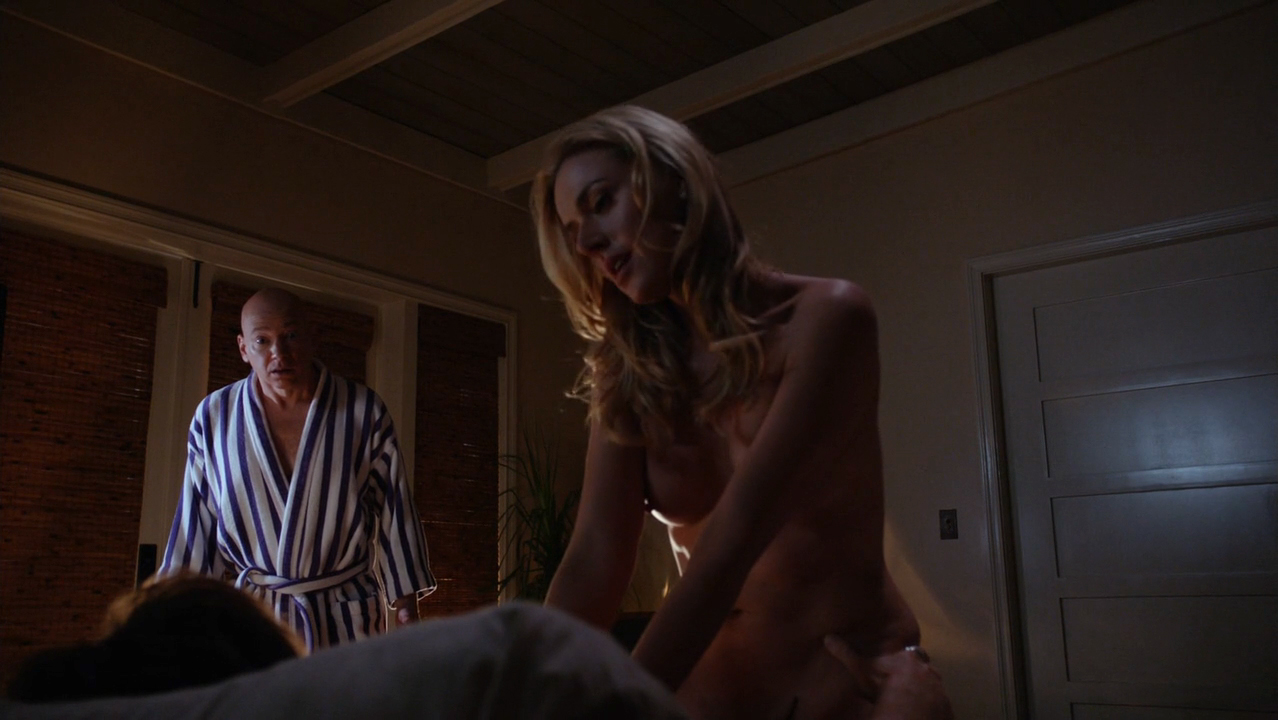
Californication S06E04

"Once a bottom feeder, always a bottom feeder..."

Charlie wants Hank to work on a film about the underground gay S&M club scene in New York City, and this requires a lot of effort from everyone. Charlie pretends to be gay so he can cozy up to Robbie Mac and secure the writing gig–possibly by giving Robbie a blowjob. Meanwhile, Hank has to sleep with an agent he doesn’t really like (but that sounds like par for his course).

Should we pity Runkle? He was only trying to give people what they want, but he doesn’t want to give blowjobs – he wants to receive them – and so he ends up looking like a charlatan, a liar, and the world’s least desirable threesome partner. We have to have affection for the guy, if not because of who he is, then because he always manages to get into situations that give us ample nudity, dribbles Fleshbot. In this case, it is in the voluptuous form of Long Island native Alissa Dean. In the words of the actress, writer and producer extraordinaire herself, "My episode of Californication has lots of leather, lots of gay men, lots of sex… kind of the three best things ever!"


Television Series: Californication (S06E04)
Release Date: February 2013
Actress: Alissa Dean & Allison McAtee
Video Clips Credit: Deep at Sea


http://dfiles.eu/files/x00qw56ye
https://hotfile.com/dl/193723485/15ebc4b/783.zip.html
http://www21.zippyshare.com/v/65516060/file.html
http://www.putlocker.com/file/68158C3387EBA5AE
http://www.sendmyway.com/dseowa04bu9g/783.zip.html
http://www.sharebeast.com/zpclebg7lg3z
http://www.ziddu.com/download/21554783/783.zip.html
https://netload.in/dateisEupKu0H7J/783.zip.htm
Read more on this article...

Shameless US S03E04

Sometimes chasing a dream is scary. Like when you graduate and realize you want to be an actress. So you pack up your things and you move to L.A. and you use all your training – how to do a voiceover, how to shoot a commercial, how to speak on camera – and you work, because that’s how dreams are made. You land your first movie role, then your first television project. Your friends see your face in their living rooms. For Kentucky-born Galadriel Stineman, dreams are becoming reality, as she recalls auditioning for roles in California. "If you’re the one person at the end who gets the role, you feel like you’ve won the lottery," she says. Stineman has starred in a movie for the Cartoon Network, as well as an indie film with Vivica A. Fox and two episodes of the HBO series True Blood. "I just had to believe in myself and hope that would be enough," Stineman says of her decision to go to Hollywood. "I knew this was the time."

Since she was a little girl growing up in river cities like Newport, Bellevue and Dayton, Stineman has been a performer. She directed pageants and other competitions with friends in her living room. She told teachers her name was Dorothy — as in The Wizard of Oz. And once she frightened her mother when out of the blue she announced, "I’m so tired. I can’t run any more." It was one of Dorothy’s lines in the movie. Even her name, Galadriel, sounded like something from a movie, taken from one of Tolkien’s elven queens in The Lord of the Rings, which her mother was reading when she was pregnant. It’s pronounced Guh-lay-dree-ool.


Stineman knew, even as a child, where she really wanted to be. "I’ll be living in California in a big house with lots of exotic animals," she would say. Yet she never became a child star like Union’s Josh Hutcherson, who made movies before he was 10, or Louisville’s Jennifer Lawrence, who was discovered at 14. Stineman participated in the drama club but never captured a starring role in a play at Newport Central Catholic High School. She had one line in Annie. She was a cheerleader, dancer and competitive horseback rider. Still, there was something within her. Something that would not be denied. "She has always had a flair for the dramatic," says Stineman’s mother, Peggy. "I saw her speak to an assembly in third grade, just a few lines, but I saw how she owned the stage."

And when she enrolled as a freshman at Northern Kentucky University, she found herself in front of the camera, taking electronic media classes in the College of Informatics. She excelled in school. An interview she conducted with local television anchor Sheree Paolello is used today as an example of great classwork. "Galadriel is a charming person — sunny, fun-loving and genuine," says her former communication studies professor Russell Proctor. "I can’t say that I knew she would be a Hollywood star — I never saw her act. But I knew she would be great at whatever she pursued."

Stineman has a face made for the camera. She is pretty, petite, with red curls and green eyes. She read Los Angeles Magazine throughout college, and she’d developed a relationship with representatives at the Northern Kentucky-based Katalyst Talent Agency. "I knew that she had a certain spark right away," says Kim Vance, assistant director for student life at NKU. "I expected her to do very well because she has wonderful communication skills and people skills."

Deep down, her mother knew what she was going to decide. "Galadriel has always been allowed to make her own decisions," says her mum. "But this topic was so foreign to me, I just had to offer love and support." Stineman thought about cost. It’s twice as expensive living in Los Angeles than Northern Kentucky. She thought about being lonely. She thought about whether or not she could survive. "It seemed like then or never," Stineman says. "I had no idea if the opportunity would come again." She moved to Burbank in the fall of 2007. Her connections with the Katalyst Agency got her an agent in California. "Those agents signed me on the spot," she says. "Having great representation right off the bat probably shaved years off starting my career." She was on the right track. The question was, would it all work out? It didn’t take very long to find out.

After settling in California, Stineman’s connections helped her land a starring role in a small budget indie film. "My first movie role was in [2010’s] 'Junkyard Dog' with Vivica A. Fox and Brad Dourif," Stineman said. "We had a couple rounds of auditions with the director and casting director." Stineman’s manager, Kurt Patino, took notice in her shortly after that role. Patino has been a manager for eight years and was a talent agent for six years before that. He said that his biggest discovery as an agent was America Ferrera. "Galadriel was introduced to me through an entertainment industry colleague, and as soon as I met her, I could tell she was very smart, very passionate about acting and very willing to follow the advice necessary to achieve success in Hollywood," Patino said.

Sharing time on screen with Vivica Fox, Stineman gained valuable experience that led to more opportunities. Another starring role followed in the television film adaptation of the popular children’s cartoon Ben 10: Alien Swarm. That made her a star — at least within a particular subset of fans. "When I booked my first role, I felt completely validated in my pursuit," she says. "I had always wondered if I could actually do this for a living and once I booked my first job, it was like, 'OK, someone other than me thinks I have a place on the screen.'"

Those appearances have led to others. Originally, Stineman says, she decided to try the acting life for nine months. Now, she’s been supporting herself for almost six years, appearing in television shows including The Middle and True Blood, and starring in movies including the teen comedy The Party is Over and a Hallmark television film called Operation Cupcake. "There are days when I think about some of the projects I’ve worked on and can’t believe it," she says. "Especially True Blood. I’m a huge fan of the show and I remember specific times when I said things like, 'I’d probably keel over and die if I ever got to be on that show.'"

The Hallmark movie got her a little more exposure, she thinks. "I play the 16-year-old daughter of Dean Cain (New Adventures of Superman) and Kristy Swanson (Buffy, the Vampire Slayer.) In this movie, my dad is a career military man who is back with his family for the first time in a long while. He’s trying to fit in to their lives, while also deciding if he should accept a promotion or retire and spend more time with us. It’s a really touching movie and I’m proud to have beeen a part of it." Stineman’s character on The Middle is a tutor for Charlie McDermott’s character, Axl. "My comedy idol has been Patricia Heaton for a couple years now," Stineman said. "I started working on The Middle so I’m now working with her, which is very exciting." "When I see Galadriel in a show or movie, I always smile as I watch her become another character," mum Peggy says. "Sometimes I recognize some of the facial expressions as those I saw when she was a child."

Patino’s job is to motivate Stineman’s career through collaborating with her through choice of headshots, networking and teaching her about the industry in general. Stineman and Patino met early in his managerial career and, according to him, it has been one of his greatest and most rewarding business relationships. "I knew she had a natural talent, and the steel nerves needed to compete in an audition situation," Patino said. "She also is a very smart girl, and I knew she would explore ways to become a better and better actress as time went by and have the discipline to always work hard to achieve her goal of making it as a working actress."

As Patino introduces her to agents, casting directors, coaches, attorneys and publicists, Stineman has also met a few actors too. "I worked on Showtime’s Shameless a couple months ago and got to hang with William H. Macy one of the days. Picking his brain about theatre and life was an honor," Stineman said. "One thing the best actors I know all have in common: they don’t make excuses. Be accountable for your success and don’t be a victim. Excuses will not get you close to where you want to go. They’ll just keep you busy while someone else gets what you want."

That said, Stineman doesn’t feel like she’s made it. Not yet. But she loves what she’s doing. "I have no idea where I’ll be in a few years, because I have so many interests," she says. "I just like to make sure I’m doing the best I can at whatever I’m pursuing, and that it makes me happy. When it stops making me happy or makes me doubt who I am, I know it’s time to make changes. For now, (acting) makes me happy. I feel like I’ve got further to go, it pays the bills, and I have a great team. I’m not stopping anytime soon!"

Television Series: Shameless US (S03E04)
Release Date: February 2013
Actress: Emma Greenwell, Shanola Hampton, Galadriel Stineman & Emmy Rossum
Video Clips Credit: Deep at Sea


http://dfiles.eu/files/vbzbw23t1
https://hotfile.com/dl/193849439/0f7faa4/785.zip.html
http://www.putlocker.com/file/59FF96E86F315FA8
http://www.sendmyway.com/duac03yus10j/785.zip.html
https://netload.in/dateiIkFV145ee7/785.zip.htm
http://www.ziddu.com/download/21561401/785.zip.html
http://www43.zippyshare.com/v/75498561/file.html
Read more on this article...

Girls S02E05

In Hollywood, it seems you’re only allowed to be naked if you’re Megan Fox. If you’re not, you had better be apologetic about it, like Melissa McCarthy in Mike & Molly. But God forbid you’re a woman with an unconventionally beautiful body and you’re okay with it, writes Salon's Soraya Roberts... That’s when people like Howard Stern start to get hysterical: Lena Dunham, whom the radio host described as a "little fat girl who kind of looks like Jonah Hill" and likened her taking off her clothes to rape, has become a feminist heroine largely due to the fact that she unapologetically parades her naked body across the TV screen. Dunham has been both derided and deified for baring her unconventionally beautiful figure throughout both seasons of her HBO series. (And don’t expect her to stop anytime soon, she told Entertainment Weekly in a February cover story: "My point with getting naked is never proven.") And through her performance, she has established a new body ideal. Carolee Schneemann, the feminist artist who originated nude performance art in the ’60s and was dubbed "body beautiful" for her stunning figure, believes Dunham does more than add a dose of reality to the "deformations" – "the swollen puffed up lips, the emaciated shapes, the huge inflated boobs" – that populate Tinseltown. "There’s nothing deformed about Dunham," she said. "She’s the ideal of normal."

Five decades after female artists first started exposing their bodies in public, Dunham has absorbed this feminist art tradition and dragged it into the realm of the mainstream. In the second season premiere of Girls earlier this month, the 26-year-old actress, writer and director’s body took center stage three times in a space of 30 minutes: once before the credits as her character Hannah Horvath bounced on top of her boyfriend, once when she changed her dress in front of a friend and once in the closing scene when Hannah stripped off to reveal her thong to the camera. Though only four other episodes have aired since then, Dunham has appeared naked, in some form, in all but one. In the third episode, Hannah gets high on coke and trades tops with her dance partner, who, unfortunately, is rocking a yellow mesh shirt. Hannah removes her top in the middle of the dance floor to reveal her naked chest, which is barely covered by the Day-Glo fishnet she proceeds to wear through a Metro Drugs. "I usually hate when you wear your nipples out in public like that," says her gay ex, Elijah, mid-snort. "But you look so beautiful right now."


The second series’ surge in flesh sparked a parallel surge in press that had been brewing since the first season. In December, Hello Giggles had already published an article entitled 'Why Lena Dunham’s Body Matters (and Why It’s Ridiculous That It Does)' only to be eclipsed by the show’s racial anemia. But now that season two has kicked off with a black cast member, "it’s time to properly freak out about Lena Dunham’s body," as the Daily Beast puts it. New York Post TV critic Linda Stasi called first dibs on the wunderkind for having "giant thighs, a sloppy backside and small breasts," while Stern added, "I don’t want to see that."

"People are saying, 'How dare she show her body? She doesn’t have the perfect body!'" said Danielle Knafo, author of the 2009 book 'In Her Own Image: Women’s Self-Representation in 20th Century Art.' "But in the ’60s, the women with the perfect bodies were showing their bodies, and they were accused of the same thing." Before Schneemann lay naked in her 1963 installation 'Eye Body: 36 Transformative Actions,' female artists kept their own nudity out of their work. "It was private, it wasn’t part of any explicit cultural discussion except as pornography or science," Schneemann said. "The taboo about penetration and moisture and intercourse, really that overrode any other aesthetic conversation." She started including herself in her own 'body collages' in response to the "constrained realm" in which female artists lived. "I thought that was suppressive and an artifice and it didn’t respond to the way I experience my own life," she said. "I thought I could work differently."

Man, did she ever. In her controversial 1967 film 'Fuses,' which won the Cannes Film Festival Special Jury Selection prize a year later, Schneemann recorded herself having sex with her boyfriend then manipulated the celluloid – staining, painting and re-editing and mixing the images with nature photographs. In so doing, she revealed how a woman’s depiction of her own sex act differed from a man’s. Despite stating in her 1976 book, titled 'Cezanne, She Was a Great Painter,' that her work was intended to make "a gift of my body to other women," Schneemann was promptly labeled a narcissist and an exhibitionist. It was a criticism largely reserved for women, claimed renowned feminist art critic Lucy R. Lippard in her seminal 1976 essay 'The Pains and Pleasures of Rebirth: European and American Women’s Body Art.'


"A woman using her own face and body has a right to do what she will with them, but it is a subtle abyss that separates men’s use of women for sexual titillation from women’s use of women to expose that insult," she wrote, adding, "Men can use beautiful, sexy women as neutral objects or surfaces, but when women use their own faces and bodies, they are immediately accused of narcissism."

Though Lippard allowed that there is an element of exhibitionism in body art – "perhaps a legitimate result of the choice between exploiting oneself or someone else" – she refused to accept that artists like Schneemann were vain. To illustrate her point, she used male performance artist Vito Acconci, whose 1971 work 'Seedbed' had him lying underneath a gallery ramp masturbating and fantasizing about the visitors above. "Because women are considered sex objects, it is taken for granted that a woman who presents her nude body in public is doing so because she thinks she is beautiful," Lippard wrote. "She is a narcissist, and Acconci, with his less romantic image and pimply back, is an artist."

While Schneemann was exposing her unblemished back on the East Coast, Judy Chicago promoted performance art on the West Coast. By the 1970s, Chicago had reportedly coined the term 'Feminist Art' prior to launching the Fresno Feminist Art Program, the first of its kind in the U.S. There, she used performance as part of a "consciousness raising objective," according to Jayne Wark, author of 2006′s 'Radical Gestures: Feminist Performance Art in North America.' Like Schneemann, Chicago employed the medium to break women out of their established position in society. "I discovered – long before feminist theory – that my young female students all knew how to ‘perform’ femininity, and I helped them translate those abilities into performances," Chicago said via e-mail, "including 'The Cock and Cunt Play,' which I wrote and used to help the students deal with their limitations because the 'female role' (as we called it then) interfered with their abilities to grow as artists."

Throughout the ’70s, performance art began to proliferate ("Women often flock to new creative areas because there are not the same institutional barriers," said Chicago), with conventionally beautiful women like Schneemann at the helm. According to Knafo, pretty performers would use their looks to "question the person with the gaze." In Hannah Wilke’s 1979 work 'So Help Me Hannah: What Does This Represent/What Do You Represent (Reinhart), 1978–1984,' for example, the artist sat in a corner lost in thought, naked, her legs spread. "It would ordinarily be a pornographic image but it’s not because she’s got her hand on her head and she’s thinking, so you see her as a thinking woman, not just as a sexual object," Wark explained.

Though body image seemed to be less of a concern 40 years ago, Schneemann said "the same over-idealizations inhabited women’s sense of how they should be or could be," and some of that bubbled up to the surface of their performance pieces. In 'Carving: A Traditional Sculpture' (1972), Eleanor Antin recorded herself losing 10 pounds over 37 days, playing with the idea of Greek sculptors carving at marble to create ideal forms. Two years later, Canadian artist Lisa Steele blurred the gender lines when she filmed close up images of her various disembodied imperfections in the video 'Birthday Suit — with Scars and Defects.' Though Chicago admits that anorexia and bulimia weren’t yet major issues during this time, she recalls a film in Fresno by one female artist that showed "a very large, naked woman getting into a bathtub and caressing herself."

Chicago blames the 'white male canon' for the fact that, 40 years later, Dunham’s normal naked body is still considered 'shocking.' "When I created 'The Dinner Party,' I believed that I would be able to break the cycle of erasure that it recounts in which century after century, women do not know what women before them thought, taught or created," she said. "Now I understand that we are still IN that cycle largely because the mainstream institutions (universities and museums) perpetuate a male-centered curriculum and art in which women are ‘added on.’"

But Dunham is breaking the cycle in one institution at least: Hollywood. The self-styled feminist knows about Chicago’s work, even if precious few others in Tinseltown do. Last April, in response to L Magazine’s question of who she would invite "living or dead" to her fantasy dinner party, Dunham listed off everyone from Katharine Hepburn to Tavi Gevinson and said they would all be eating "on plates designed by Judy Chicago." And while still a student at Oberlin College, Dunham appeared to give Chicago another nod with her 2008 performance piece 'The Fountain,' which she uploaded to YouTube. According to the New Yorker, the video (which was removed after garnering 1.5 million hits) showed the 21-year-old student breaking the rules by stripping down to a bikini and performing her ablutions in the campus fountain. Dunham’s work reminded Wark of Chicago’s 1972 performance piece 'Ablutions,' a meditation on rape that included a tub in which women were "bathed."

Over the years, Dunham continued (and continues) to include the art world in various forms in her work. In her first series, the 2009 web show 'Delusional Downtown Divas,' which was made for the art magazine Index and includes a cameo by ’60s performance artist Joan Jonas, three pretentious New Yorkers attempt to cash in on their 15 minutes in the local art scene. And in her subsequent indie meta-feature 'Tiny Furniture,' Dunham’s college-grad alter ego moves back in with her artist mother (played by the director’s own mom, photographer Laurie Simmons). Then there’s Marnie, the wannabe curator in Girls who realizes in the second season that she may already be a dinosaur.

For better or worse, Dunham was weaned on art. Her mother is a photographer who creates domestic miniatures with dolls, and her dad, Carroll Dunham, creates paintings "inhabited by rectangular shapes sprouting male genitals," according to the New Yorker. In an interview with Baltimore City Paper in 2011, Lena admitted that, on top of the semi-autobiographical subject matter of 'Tiny Furniture,' her mother’s photographs inspired the film’s minimalist aesthetic. And despite her father’s refusal to appear in her projects, Lena described his work as having "kind of an interesting body-sexuality thing to it that I think I found sort of liberating and inspiring."

Knafo, a psychoanalyst as well as an art historian, believes Lena’s parents may be the key to why she uses her own body in her work. "Sexuality, dolls, these are things she grew up with, and where did that leave her relationship to her own body? Her own body that is overweight for our culture?" she asked. "Her putting herself out there naked over and over again is in a way saying, 'Look at me, I’m OK.'" To her credit, Lena basically said the same thing in a New Yorker profile that called her nudity "a pre-emptive strike against disparagement." "I live in this constant state of 'This is what I look like — fuck you!'" she said, "and being, like, 'I am so sorry, I want to cover myself up.'" In an interview in the Hollywood Reporter earlier this month, she added that her penchant for nudity "does not come from a place of confidence and is a compulsion."

Regardless of the psychological motivation behind taking her clothes off, Lena’s nudity is having a positive affect on American society’s psyche. "Lena Dunham is in a way desensitizing the culture by showing her naked body," Knafo said. "All the reactions to it show all the prejudices that people have about what kind of female body is fit to be seen in the public." Feminist icon Gloria Steinem told New York magazine’s Vulture blog of the HBO show earlier this week, "I am so relieved to see real people saying real words."

It’s about time, considering that bodies like Lena’s were even less welcome in the arts 50 years ago, according to Schneemann. "When I used my naked body, if it hadn’t been ideal, I couldn’t have made any inroads into perceptual consciousness — I would simply have been laughed off," she said. "But my body was able to confuse the issues because it worked as a double agent: It was conventionally attractive, it could receive attention, and then, what it was doing in terms of my own creative imaging was subverting expectations."

Lena’s goals are not so lofty. She claimed in an interview with artist Miranda July in this month’s Interview magazine that she was thankful that, in the ’70s, her mother and other artists of the Picture Generation, such as Louise Lawler and Cindy Sherman, "were trooping around and stuffing their photos in everyone’s faces and saying it was OK to have a show that wasn’t about big theoretical ideas about math and structure and theory." Lena is a master at the art of simplicity. While Sherman continues to put on masks, Dunham removes them, both literally and figuratively. "It’s very matter-of-fact — and that’s one of the reasons it has made an impact," XO Jane editor Jane Pratt told Salon earlier this month of Lena’s nudity. "It’s not like she’s trying to make a statement." While feminist artists questioned the gaze with their beautiful bodies, she uses her normal body to ignore it. "What Girls says is 'Fuck the gaze,'" wrote Ta-Nehisi Coates in the Atlantic. "Lena Dunham ain’t really performing for you."

Which is not to say she isn’t performing. Lena is a savvy writer and director who is deliberate in her choices, including when she takes her clothes off and what parts of her body she reveals. And just like her '60s foremothers, her nude performance is less about art and more about raising awareness. As Steinem explained to Vulture, "The more rebellious we become politically and economically in our lives, the more society tries to tell us that there’s something wrong with us," including our bodies. Girls helps bring us back to normal. "The fact that Hannah exists on TV and is not a size 4 is meaningful," Lena told UK Metro this year, adding to the New York Times, "I have a body that is outside of the Hollywood norm, and it’s not the kind of body I ever thought would be seen naked on television."

Television Series: Girls (S02E05)
Release Date: February 2013
Actress: Lena Dunham
Video Clip Credit: DeepAtSea


http://dfiles.eu/files/ttwdiz9uq
https://hotfile.com/dl/193845021/8b8e865/784.zip.html
http://www65.zippyshare.com/v/38050855/file.html
http://www.putlocker.com/file/6A8A0D7AE1961E29
http://www.sendmyway.com/s6aoglku62c7/784.zip.html
https://netload.in/dateiFX0pO6d3LK/784.zip.htm
http://www.ziddu.com/download/21561226/784.zip.html
http://www.sharebeast.com/34ymkdia4v8f
Read more on this article...

Sunday, 10 February 2013

Sinful Sundays … And Beyond

January is a debaucherous month at Showtime. After all, it's when the network’s trio of serially addicted men — Frank (William H. Macy) on Shameless, Marty (Don Cheadle) on House of Lies, and Hank (David Duchovny) on Californication — all return to the pay-network to get back to the business of being bad. So it's quite fitting that Showtime labelled Jan. 13, the date that all three shows began their new seasons, "Sinful Sunday," notes Hollywood.com's Kelsea Stahler...

But while we’ve got a serial drinker in Frank, a career liar in Marty, and a compulsive fornicator in Hank, the characters are hardly just sinners. Fans of the three series would agree with President of Entertainment at Showtime, David Nevins, who notes Frank, Marty, and Hank are far more layered than your average bad boys. "We try to make sure that all of our characters have a real complexity to them, and that goes for both men and women," he says.

So while Macy, Cheadle, and Duchovny's roles are characters that could likely only exist on a network like Showtime, Sunday's well-rounded trio impossible to pigeonhole. "I think [Macy and Cheadle] are making full human beings," Duchovny says. "Across the board, [these characters are] human." That's likely what makes House of Lies the top performing comedy on Showtime, according to Nevins. It's also probably what brings fans of Hank Moody back season in and season out and keeps Shameless fans — a notoriously obsessive set — as rabid as ever for more Gallagher family hijinks. Of course, each of the series' leading men have their own ideas about what keeps the fans coming back for more.


As the patriarch of Shameless’ Gallagher family, Frank isn’t exactly the poster child for father of the year. The perpetually drunk (or, at the very least, tipsy) South Side Chicago native is a man only his family (and Macy... and Shameless fans everywhere) could love. Macy gets that, and it’s what makes his job so challenging. "This is my take on Frank," he says. "He’s smart, he’s funny, he’s got a wicked sense of humor. He sees the irony of life and so he holds things somewhat lightly, but he’s very hard-working, entrepreneurial, and dogged. He never gives up." Of course, that’s not exactly what most people would say about Frank, who ended last season asleep in the Chicago snow after punching his son Ian (Cameron Monaghan) over a case of Old Style beer. "I like the guy. [Laughs] But at the same time, he’s deplorable," says Macy. "If I do my job right [the audience] will have enough forgiveness in them and the next week they’ll tune in again."

So the audience may continue to come back for more, but what about the Gallaghers themselves? At the end of Season 2, they seemed to have had it with Frank. But all is not lost — Fiona (Emmy Rossum) and Co. may be a wild bunch, but when it comes down to it, they’re family. "I happen to know the family is not done with Frank, nor will they ever be done with Frank," Macy says. "As perplexing as it is, even to me, there’s a part of it I find very moving. We say blood is thicker than water and that family trumps all, but the Gallagher family is living proof of that." Heading into Season 3, Frank faces a few additional challenges beyond his own addictions. "At the end of this next season, he’s got some health issues … he bears his health problems stoically," Macy says. So it seems, even Frank can figure it out when the straights become dire. Macy’s not hoping Frank gets it allfigured out though. "I’ve got the role of a lifetime," he says. "At first [my scenes] are uncomfortable and icky, but if I just [bring] up [my] courage and throw [myself] into the scene as Frank would do, oh boy, I feel like the king of the world."

Sinful Sunday's youngest member is the sophomore series House of Lies, produced by and starring Cheadle as Marty Kaan, a leader in the ruthless, opportunistic world of management consulting. Together with the rest of his pod — or team of consultants — he swindles his way into deals with major corporations, but such a ruthless existence has its consequences outside of the office. But those consequences have led to success for the network and Nevins, who boasts House of Lies as the 'strongest comedy on our schedule, ratings-wise.' "It just feels like this show is starting to happen," Nevins says. Even Macy admits he’s a fan, albeit a jealous one: "Cheadle is just great, but he should pay them to do that role," he says.

Indeed, Cheadle is enjoying the freedom of starring on a Showtime series. "There’s definitely a style of writing that appears on cable that definitely doesn’t happen anywhere else … definitely not on network television and unfortunately, not any more really in the movies, a lot of times," Cheadle says. According to the critically beloved actor, his series steps outside the boundaries of most other cable and pay-cable series. "I don’t know a lot of shows that deal with cross-gender kids and deal with parents and how to talk about that, and I don’t see a lot of [Marty’s son] Roscoe and not a lot of black leads in anything, so I think we were just able to stretch out in ways that are a little different," Cheadle says.

Season 2 is also going to allow the characters themselves to stretch, now that the ordeal of explaining the giant world of management consulting has been dealt with in Season 1. "We’re getting to know everyone a little better," he says. "We’re getting deeper and more nuanced … bringing in elements of race. [And] one of our characters deals directly with the Occupy [Wall Street] issue." Of course, social politics add dimension, but fans of the show are likely waiting in fitful anticipation to see what happens between Marty and Jeannie (Kristen Bell) after last season's finale, during which she broke up with her fiance and the narrative hinted that it had something to do with her hooking up with Marty.

Cheadle says Season 2 will have some serious work to do in sussing out what it all means for their relationship after their implied moment: "Well, we’re definitely trying to figure out what happened between Marty and Jeannie. Is this the start of something?" After all, that's a question that lingered throughout the show's first season. The duo has spent 12 episodes flipping back and forth between potential romance and potential mutual destruction. "I think they clearly had this love, this strange dynamic between them of partners, and friends, and adversaries," Cheadle says. Of course, the actor won't tell us exactly where Marty and Jeannie will find themselves once they broach the love subject, or whether or not that hint in the season finale was a giant tease. We’re not that lucky.

Last, but not least, comes Duchovny’s seasoned Showtime vet Hank Moody, the champion fornicator of Los Angeles. Over the five years we’ve known Hank, we’ve followed him through his life as a writer in Los Angeles: He wrote a book, taught some college classes, stood trial for statutory rape, wrote a movie for Rza of the Wu Tang Clan, and now, in Season 6, he will take a stab at writing a musical. Clearly, nothing is off limits for Hank. But, of course, despite Hank's many talents, his main draw will be the series' original peg: his apparent sex addiction. Of course, as he embarks on year six of Moody’s chronicles, Duchovny wants to make it known that Hank is more than a rapscallion. "I tend not to think of [Hank] with one flaw, but as flawed. And by flawed, I mean human," he says.

Despite his seemingly unwieldy life, Hank is always brought back to earth by some circumstance or consequence for his actions. It’s a cycle that works for him... and for Duchovny, who’s not looking to morph Hank into something he’s not to keep the show 'fresh.' "I think it’s a temptation over a long-running series to try to reinvent the character, when in fact the character is the essence of the show," Duchovny says. "If you change the character and reinvent it, you’re actually making a different show. As fun as it may be for the actor, it’s kind of a dissolution of the bond you’ve made with your audience," he adds. That’s why, time and again, Hank goes through his own form of 'reinvention,' according to Duchovny. "The touchstone for Hank instead of reinvention is to come back to the original relationship [with Karen and Becca]… It’s a rediscovery of what’s most important to the characters."

Heading into Season 6, that’s exactly where we’ll find Hank, who’s just survived his crazy girlfriend’s attempted double suicide. "This year picks up with him getting physically better in the first episode," Duchovny says. If we know anything about Hank, it’s that he seems to be able to survive anything. And his reward, this year, is a little time with guest star Marilyn Manson, who Duchovny says got on the show by emailing with the creator Tom Kapinos. "[Manson’s] a fan of Hank’s and Hank’s a fan of Manson," he says of the rocker’s two-episode stint in which he plays himself.
And while Duchovny’s excited about the guest star, he’s mostly excited to be back. "If we weren’t brought back, then that would have been the end of the show — Hank would have been killed by his crazy lover," he says. Luckily for Duchovny, and for his fans, Hank Moody doesn’t go down that easily.

So Sundays are loaded up with plenty of laughs and drama in winter, and the success of shows like Shameless, House of Lies, and Californication will only lead to more off-the-wall content on the network, like the upcoming Showtime series Ray Donovan, about a professional "fixer" for wealthy families, and Masters of Sex, about the pioneers of the science of human sexuality, airing sometime in 2013. "I feel an enormous sense of freedom and opportunity right now [because] the best people in the business want to be making shows on television," Nevins says. "We’re reaping the benefits." Lucky for audiences, we all share in that bounty, too.
Read more on this article...

Nip Alert For Silicon Valley Casting

In an exclusive to Deadline, it has been revealed Christopher Evan Welch, Amanda Crew, Angela Trimbur, Zach Woods and Kumail Nanjiani are the latest names set to co-star in Silicon Valley, HBO’s single-camera dark comedy pilot from the King Of The Hill trio of Mike Judge, John Altschuler and Dave Krinsky and producer Scott Rudin. The five join previously cast T.J. Miller, Thomas Middleditch, Josh Brener and Lindsey Broad. Silicon Valley is set in the high tech gold rush of modern Silicon Valley, where the people most qualified to succeed are the least capable of handling success. The pilot will be directed by Judge (Office Space) from a script he co-wrote with Altschuler and Krinsky. The trio also previously worked together on the short-lived The Goode Family, and MTV's recent revival of Beavis and Butt-Head, but this is their first live-action project. The script review on Ain't It Cool News was not very flattering, although the source noted that the script was from October so it may have been improved since then. At the time, the characters were one-dimensional stereotypes, but now that living, breathing actors have been cast in these roles, let's hope that the script has been fleshed out.

Welch, of the AMC series Rubicon, is on board as Peter Gregory, an eccentric tech billionaire who is the most successful entrepreneur in Silicon Valley. According to an early review of the pilot script on Ain't It Cool News, the character is modeled after Peter Thiel, the co-founder of PayPal and the first outside investor in Facebook. Canadian actress Crew (Sex Drive) will play Peter's head of operations named Monica, who serves as his human touch. In addition to being bright and highly competent, Monica is described as downright beautiful by Silicon Valley standards. menawhile, Trimbur (The Future) has landed the role of Langdon, an unemployed publicist carrying a mountain of debt. She has given up any hope of finding the wonderful and wealthy man of her dreams in Los Angeles.


Another former Office cast member, most memorable for his creepy and cloying performance as Gabe, Woods plays against type in the Silicon Valley pilot as a hard-working and enthusiastic young business executive named Jared. I guess he wasn't the Scranton Strangler after all. Kumail Nanjiani of TNT's Franklin & Bash will portray Dinesh, a tech geek resident of Erlich's Hacker House. Looks like we have our Indian caricature as mentioned in the script review.

Middleditch (The Campaign) is already down to play Thomas, a budding tech wizard who is focused, idealistic, and brilliant when writing code for software, but awkward and insecure in all other aspects of life. He moved from St. Louis to California to make his dreams come true in Silicon Valley. Best known for holding the camera while running from monsters in 2008's Cloverfield, T.J. Miller is the owner of the "Hacker House" named Erlich. Described as the big fish in the small pond he created, Erlich is blessed with an intellect eclipsed only by his imperious self-satisfaction and has very little sense of self-awareness.

Brener (Glory Daze) plays Thomas' best friend and confidant called Big Head, an unfortunate grade-school nickname that stuck despite his normal-sized head. Big Head earns his spot in the Hacker House — as well as the respect and adoration of Erlich — by developing an app called "Nip Alert" that somehow alerts the user to the location of women with erect nipples.

Finally, Lindsey Broad, who played the temp worker that tried to seduce Jim on NBC's The Office last season, has been tapped as Tandy, described as "a loyal friend who would never have sex with her girlfriend's boyfriends". She is also described as "attractive in a friendly, slightly sloppy way," whatever that means. Tandy is a realist about her desire to marry into a comfortable life, but she still has a hint of the romantic in her.

In his scathing script review from ealy last month, Nolan Night had the following to say...

"If this script is unchanged as HBO begins production, it will be one of the worst pilots HBO has ever aired. The draft I read is dated mid October, so God willing Mike Judge (and other writers John Altschuler & Dave Krinsky) get their act together. Frankly, I had to re-read this twice to really take in just how God awful it is. Even shorter review: Mike Judge drives through Silicon Valley. Once. He then fills a script with uninteresting stereotypes. It is not funny. At all.

So you're still around- so why do I hate it so much? The writer's disdain for Silicon Valley is evident from the OPEN. The credit sequence references gaudy billboards and "shit brown colored hills of Mountain View" and geeks doing things that the audience "doesn't understand." This is a recurring theme by the way- these stupid geeks with their alien geek culture. Our main character, Thomas, is living in some sort of a geek house, where his older benefactor Ehrlich runs a geek household of promising geeks working on geeky programs. For instance, Thomas is working on a program called "Pied Piper" which delivers "melody" recognition. Our story takes off ::cough:: when Ehrlich tells Thomas he has to get the hell out of the house because his computer program sucks. I guess if your program doesn't suck you can hang around in the "hacker hostel."

By the way, I've ignored a few other house characters because frankly, they aren't worth noting. One is a black guy. One is an Indian guy. One is an Asian guy. And one is a fat white guy. Seriously. Thomas's best friend, Big Head, is named Big Head because he has a big head. That's how the script describes him. (One more note: the Asian cusses! Isn't that hilarious? Remember when that happened in the Hangover?!) Ehrlich says Thomas needs to work on an app with a more practical purpose. Like Big Head's idea "Nip Alert" which tells people when women's nipples are erect. /sigh, the Nip Alert idea could be funny, if this script had any idea what to do with their stupid humor ideas. But we are supposed to take this at face value and buy into the fact that this is a real world representation of Silicon Valley. By the way, these "genius" stereotypes actually figure out that Big Head's idea is stupid/impractical 30 pages later into the script

So Big Head and Thomas go to work, (at a Google esque company, Boodle). Where they talk about the industry giant Peter Gregory (thinly veiled Peter Thiel) and go and see him speak that evening. But before they get through that, Judge has to introduce new characters at Google, excuse me Boodle, called BROGRAMMERS. So these particular "genius" Silicon Valley programmers, the script lazily refers to as "frat guys" "who clearly only work out their upper bodies" and OF COURSE they make fun of poor Thomas and his Pied Piper music program. Oh and they totally LOVE their DOUBLE MACHIATTOS. Because that's what Brogrammers drink Bro.

Anyway, yada yada yada it turns out Thomas's program has an mp3 esque revolutionary aspect to it- it can COMPRESS mp3 files! Woah. Peter Thiel, excuse me, Gregory and the EVIL CEO of Boodle Gavin start a bidding war over it. WHO WILL THOMAS CHOOSE? THE EVIL CEO and all of his money or the revolutionary Peter Thiel cough Gregory, who offers Thomas less money but more involvement?! Dun, dun dun.

I'm sick of reviewing this because frankly, re-reading it has reminded me of how disappointing it is. One sideplot, I'm not kidding, is two hot women (a laid off publicist & a non prof worker) deciding to date geeks because they have money. (The script has them looking at an MSNBC broadcast and commenting "Well they don't look rapey.") Seriously, that's a sideplot that happens. If this were in any way presented as humorous, I could buy in. Instead it's just ANOTHER lazy stereotype.

This isn't Office Space humor of reality/biting sarcasm. This isn't Idiocracy humor of the absurd. It's like a drive by concept, that in execution lacks any semblance of humor, because the world they've created isn't believable and the characters they've populated in it lack any semblance of reality. There's no Peter Gibbons here. Just "geeks" and "brogrammers." Ha. Ha."

Read more on this article...

Saturday, 9 February 2013

Banshee S01E05

In Cinemax's new action drama Banshee (already picked up for Season 2), Antony Starr plays a thief who assumes the role of sheriff in Banshee, a small town in Pennsylvania's Amish country, yet finds it hard to escape his past. Jonathan Tropper and David Schickler created the show, which also boasts True Blood's Alan Ball and House alum Greg Yaitanes as executive producers. Yaitanes explains to TV Guide why we should all visit Banshee...

I've got room in my life to watch one more show. Why should it be yours?

There's always room for dessert. Banshee is a delicious mix of sex, action and drama.

Who should be watching?

Anyone digging Breaking Bad, Homeland, Sons of Anarchy or The Wire. Fans of action films and graphic novels. Every single member of my family.

What happens if we don't watch your show?

You're missing out. Banshee's 10 episodes will take you on a very satisfying journey. We do in one season what most shows drag out for five. It's packed.

Give us an equation for your show

Witness plus Warrior times Tarantino minus the boring parts of No Country for Old Men divided by Sex and Lucia minus Lucia.

What's the best thing anyone has said or written about Banshee?

That it's the perfect blend of character and genre and not like anything on TV right now.

What's the worst thing?

"What's Banshee?"

What's an alternate title?

Downton Abbey. But we couldn't use it for obvious reasons.

Come up with a premise for the spin-off

We have it. It's called Banshee: Origins, and it's an online series along with a graphic novel of the show's backstory.

What credit of yours would you prefer we forget?

The pilot to Cleopatra 2525.

Amish TV is hot right now. Tell me something unique about your Amish characters

Two words: "Amish gangster."

If you weren't producing this show, what series would you most like to be an executive producer on?

Family Guy. Seth MacFarlane and his writers are fearless.

Why is your cast the best on television?

It's a largely European cast playing Americans, which I had very good luck with when I was executive producing House with Hugh Laurie.

Let's scare the network. Tell us an idea that didn't make it to the screen

The great thing about pay cable and working for Cinemax is there is no scaring them.

Pick another show to start a fake feud with

We shoot Banshee across the street from Homeland and will thrown down on softball anytime.

What show would you like to do a crossover episode with, and how would that go?

The Sopranos. Tony and the gang would fit right in. That's the bar we hold ourselves to and hope people engage [with] and discover Banshee.

How will your show change the face of TV as we know it?

By embracing multiple media platforms from our inception, Banshee will redefine TV in terms of "trans-media," meaning there are multiple platforms and layers to enjoy and engage the show on. I'd urge that anyone watching makes sure to watch the title sequence carefully since it changes every week and to stay for the end credits since there is something waiting for you at the very end of each episode.


Television Series: Banshee (S01E05)
Release Date: February 2013
Actress: Lili Simmons
Video Clip Credit: DeepAtSea


http://dfiles.eu/files/r99g2qzu4
https://hotfile.com/dl/193487448/d70e482/782.zip.html
http://www.putlocker.com/file/C9F342026DFF0968
http://www.sendmyway.com/yj9jw1dpahgh/782.zip.html
http://ge.tt/65HEeuX
https://netload.in/dateimcchJO6ZQu/782.zip.htm
http://www.ziddu.com/download/21546457/782.zip.html
http://www.sharebeast.com/yb22r8p3li0m
http://www9.zippyshare.com/v/77250786/file.html
Read more on this article...

My Prostitution Phase

Disappointingly, an introduction to Ellen Love, the saucy turn-of-the-century courtesan captivating Sunday night television audiences in Mr Selfridge, does not take place behind an ostrich feather-draped screen in her dressing room. There is no corsetry cinching her tiny waist, no champagne coupe dangling from her fingers in a studied gesture of lassitude – just a bog-standard Starbucks at her publicist’s. This is probably because Miss Love, music hall darling, gentleman’s muse and the newly-crowned Spirit of Selfridges (circa 1909) tends to arrive as her modern-day alter ego, actress Zoe Tapper. But happily, as Mr Selfridge has just been commissioned for a second series, she makes for equally charming, if less relentlessly coquettish company, notes the Telegraph's Judith Woods...

Tapper, 31, who is married to fellow actor Oliver Dinsdale and has a 21-month-old daughter, Ava, is poised yet quirky in an Olivia Rubin frock, teamed with battered bronze brogues. She describes herself as “a jobbing actress”, but the expression does her something of a disservice. Dark-haired, full-lipped – think Rachel Weisz shrunk-to-fit – she’s such a slip of a size eight it’s hard to believe she launched her career in 2003 playing self-styled “protestant whore” Nell Gwyn to Rupert Everett’s debauched Charles II in the film Stage Beauty.

"That was my prostitute phase, and I was a bit more buxom back then," she says with an infectious giggle. "After I appeared in that, I kept getting cast as bawdy wenches and harlots, and being asked, persuaded, and in one instance bullied into doing nude scenes. Honestly, I can’t tell you the number of scripts I read where my character enters and, for some unfathomable reason, immediately removes her top. When you are fresh from drama school and eager to please, you will do those sorts of scenes just to appear obliging, but I've learned that I’m actually a bit of a prude and now I put my foot down and am much more discerning."


After her red light days (A Harlot’s Progress, 20,000 Streets Under the Sky, The Private Life of Samuel Pepys, with Steve Coogan) came a slew of “mad psychic” roles. This kicked was kicked off with the Andrew Davies drama Affinity and eventually graduated to the conversation-stopping part of a half-blood vampire in the Philip Glenister vehicle Demons, that "probably wisely" never made it past the first series. In recent months she has filmed Cheerful Weather for the Wedding, a period version of Four Weddings and a Funeral, starring Elizabeth McGovern, which had its gala performance this week. The plot revolves round McGovern’s bride-to-be daughter who frets about whether she is about to marry the wrong man; Tapper plays her best friend. There is also a soon-to-be-released Britflick thriller, Blood, starring Brian Cox, more of which later.

But Tapper found herself inexorably drawn to the wrong side of the bedsheets once more by the complex characterization of Ellen Love, who wins the heart (albeit briefly) of Harry Selfridge, the eponymous founder of the department store, played by a dashing, bearded Jeremy Piven, star of the US cult series Entourage, who is hotter than a tamale across the Atlantic. "Ellen is quite a complex individual and there’s more to her than initially meets the eye, which makes her great fun to play. She starts out as a relatively frothy good time girl, who loves the high life and adores being plied with furs and jewels by Harry, but she also has a Holly Golighty side to her nature and there’s a lot of tension lurking beneath the surface." Her comeuppance is heralded when she makes the fatal mistake of genuinely falling for Harry Selfridge, a serial womanizer with a magpie’s eye for shiny new baubles and prizes. "Harry is reckless with Ellen’s heart, but you’ll see later in the series that things are quite as straightforward as he hoped they would be."

Where the springboard of her current show will catapult her remains to be seen, but given Piven’s "god-like" status in America, the success of Mr Selfridge there is virtually guaranteed. Tapper and her husband and daughter will shortly be joining the annual actors’ exodus to Los Angeles for pilot season, when there is a flurry of auditions (known, confusingly, as 'meetings’). "I did pilot season about nine years ago and it’s terrifying," says Tapper. "You arrive at a holding area full of actresses who all look like you, only better, then you are ushered into a room and you get a single shot at reading lines, which lasts maybe two minutes, then you’re out of there."

This time however, the excitement surrounding Mr Selfridge means her stock will be considerably higher. But it would take a pretty plum role to convince her to leave British shores on a permanent basis. Not least because she’d miss the theatre- and the shopping. "As an impoverished student I used to spend days out in Selfridges, nibbling on samples of free cheese and dousing myself with scent in the perfume department," she recalls with a nostalgic sigh. "Would I like to be the 21st century Spirit of Selfridges? Absolutely!"
Read more on this article...

Friday, 8 February 2013

Rose In Bloom

Ahead of its September bow, Showtime's hotly anticipated Masters of Sex has further added to its burgeoning cast. Lovely Bones alum Rose McIver has been tapped to recur on the drama, The Hollywood Reporter has revealed. The period piece, which stars Michael Sheen and Lizzy Caplan, revolves around William Masters and Virginia Johnson, the real-life pioneers who explored the science of human sexuality. Their research helped touch off the sexual revolution. Kiwi actress McIver- who grew up in the residential Auckland suburb of Titirangi (make up your own jokes) will play Vivian Scully, the daughter to Beau Bridges' university chancellor Barton Scully. Repped by WME and Magnolia, her credits include the features Light Years and Predicament and a recent episode of CBS' CSI: Crime Scene Investigation. "The opportunity to be working with the calibre of actors, like Bridges and Sheen, is incredibly exciting for Rose, and a real honour," said her agent Imogen Johnson.


The drama, based on Thomas Maier's Masters of Sex: The Life and Times of William Masters and Virginia Johnson, the Couple Who Taught America How to Love, is being directed by Oscar nominee John Madden (Shakespeare in Love) and begins production in March in New York for a premiere on Sunday, Sept. 29 at 10 p.m. following Homeland's third-season opener.
Read more on this article...

Thursday, 7 February 2013

Flirting With The Affair

Showtime has to decided to act on its brief flirtation with The Affair, ordering a pilot for the drama from Sarah Treem and In Treatment creator Hagai Levi. Based on their original concept, the provocative relationship project centres on the two marriages disrupted when a father of four becomes involved with a woman mourning the loss of her child, after a chance meeting at the beach. Treem, who is also an award-winning playwright, wrote the one-hour drama, which will tell the story from the male and female perspectives. Her previous credits include Netflix's House of Cards. Levi and Treem will also exec produce The Affair alongside Shameless' Mark Mylod.


It marks Showtime's third order for the upcoming season. The pay cabler previously announced a pilot order for Paul Attanasio’s The Vatican, directed by Ridley Scott and a series order for John Logan/Sam Mendes’ Penny Dreadful. This latest pickup comes as the network is preparing to launch celebrity fixer drama Ray Donovan and later, Masters of Sex, as it considers the future of Dexter beyond next season.
Read more on this article...

The Left HBOvers

Damon Lindelof is setting his sights on TV again after venturing into big screen endeavors like this summer’s Prometheus along with lending his pen to the upcoming Star Trek 2 and the beleaguered World War Z. Six months after announcing that he was developing an adaptation of author Tom Perrotta's novel The Leftovers, HBO has ordered the drama to pilot, sources confirmed to The Hollywood Reporter. As first reported by Vulture, the former Lost co-creator will co-write the project with Perrotta under his three-year deal with Warner Bros. Television. HBO will produce alongside WBTV. Perrotta also will executive produce with Ron Yerxa and Albert Berger. Should the project move forward from its development status, Lindelof would serve as showrunner.

As long as you overlook Noah Baumbach’s adaptation of Jonathan Franzen’s The Corrections, HBO has a history of successfully transforming best-selling novels into hit television shows, and now, with the help of Lindelof, the network is hoping to make the quasi-religious mystery of The Leftovers the next program eating up an hour of your Sunday evening. Perrotta’s novel, which was published in May, concerns a small town dealing with the aftermath of a Rapture-like event known as the Sudden Departure, which saw people from all over the globe vanish in an instant. The main story revolves around the town’s Mayor, Kevin Garvey, and his attempt to help his community – which saw 100 people disappear in the event – as his own family deteriorates around him. Garvey’s wife has taken up with a cult known as the Guilty Remnant and his son is now following a self-proclaimed prophet going by the name Holy Wayne. Only, his daughter remains with Kevin, but the event has left her changed, too.


The basic principle may be similar to the Left Behind series, but here, the idea isn’t leading to an eventual showdown between good and evil. Instead, The Leftovers is concerned with exploring the ramifications, and seemingly unanswerable questions of what the event actually was and how regular people are expected to carry on with their lives. The metaphysical questions posed in the novel are clearly ones familiar to Lindelof, who dealt with similarly large themes in Lost and Prometheus, so it’s easy to understand why he was drawn to the material. In an interview with Vulture, Lindelof delved into the concepts that attracted him to the book that Stephen King has dubbed "the best Twilight Zone episode you never saw," and explains how they relate to his past work...

How The Leftovers Popped Up on His Radar

Lindelof saw King's write-up of the book last August in The New York Times Book Review. "I got about a paragraph into it and immediately Amazon'd the book," he says, noting he had already read Perrotta's Little Children and Election. "And when I got the book, I fell deeply and passionately in love with it. I think that even from the moment I read the logline for the book, it was something I wanted to be vicariously a part of as opposed to just enjoying it as a consumer." Lindelof finished the novel in two days; he then got on the phone to his agents at CAA to find out if anyone had snagged the film or TV rights to the project. "They told me HBO had snapped it up when it was still in galleys," he says. Lindelof asked his agents to keep tabs on the book's development progress at HBO and to let execs at the network know of his interest.

In a bit of kismet, a few months after Lindelof found out The Leftovers was set up at HBO, the cable channel hired producer Michael Ellenberg, with whom Lindelof had become friends after working together on Prometheus. An immediate deal couldn't happen, however, since Lindelof was under contract to ABC Studios, and HBO rarely partners with outside studios on projects. It wasn't until the ABC pact expired and Lindelof signed with HBO's corporate cousin, Warner Bros. TV, that talks could begin on a deal for Lindelof to adapt The Leftovers.

Why He Was Attracted to the Project

The scribe points to two major themes in the book that caught his interest. The first was that it takes place in a world where it's now impossible to deny the existence of some sort of miraculous power. With 200 million people suddenly gone, and without explanation, "You can't be an atheist anymore," he says. "It takes us back in time to a place in human history where everyone's lives were dictated by the gods of Olympus or the gods of the heavens. [The book] tries to explain the purpose of it all, and that lined up with the meta level of Lost."

Lindelof was also fascinated by the "cool morality tale" associated with the many, many humans not chosen to be taken away. "We all look at ourselves in the mirror and think, 'Am I good?'" he says. "The fact that there's this reaping which occurred, and you don't make the cut, some of us don't feel worthy, seemed very ripe territory for a cool character drama."

The Book Is Just a Jumping-Off Point

While most of the novel's fundamentals will make the transition, expect major changes and additions. "The pilot will introduce characters and storylines not in the book. It has to," Lindelof says; The Leftovers is a relatively slim novel compared to, say, Game of Thrones. "The book is so rich in characters and details ... and opens so many creative doors," he explains. "But it probably only has enough content for two or three episodes."

Tackling Another Series With a Central Mystery

One of the main mysteries of The Leftovers is just where all the "disappeared" folks went. Lindelof doesn't want to spoil how the book tackles (or doesn't tackle) this question, but he did say the puzzle will be a key part of the show. During their talks, Lindelof and Perrotta agreed the answer to the question "did matter and [viewers] needed to know." Of course, the fact that Lindelof is working on another show with a mystery center is likely to send portions of the Internet into crisis mode today. "I told Tom to brace himself for people asking [about the rapture mystery] as the first question," he says. "And then I told him, 'I don't know if you know this, but I sort of have a reputation for not answering things.'" Lindelof fully admits he's walking into another buzzsaw, but he actually seems to relish the possible backlash. "I guess I can't help myself," he quips. "I'm sure there's a certain subset of viewers who watched Lost until the bitter end and will say, 'I'm just not going to put myself through that again.' But I'm so incredibly magnetized to this concept and the people in this story. It's firing all my creative pistons in a way they haven't been fired since Lost."

For HBO, The Leftovers joins its drama pilots including Criminal Justice, Ben Walker starrer The Missionary and Buda Bridge.
Read more on this article...

Monday, 4 February 2013

Dancing On The Edge S01E01

Joanna Vanderham, the doe-eyed ingénue of Stephen Poliakoff’s Dancing on the Edge, has risen rapidly through the ranks. Still only 22, she was plucked from the Royal Welsh College of Music and Drama in her second year to be the heroine of Sky1’s 2011 drama The Runaway, which bagged her an International Emmy nomination. Vanderham then carried the bulk of the plot – not to mention yards of taffeta petticoats – on her slim frame as the star of The Paradise, which will return for a second series later this year. She now has a Hollywood film under her belt, the yet-to-be-released What Maisie Knew, alongside Julianne Moore, and now a pivotal role in writer/director Stephen Poliakoff’s long-awaited period drama, which began last night.

What makes Vanderham so bankable, notes the Telegraph's Vicki Power, is a subtlety in her acting that belies her years. This was particularly evident during a scene in The Runaway in which the camera focused only on Vanderham’s face as her character was raped – and fear, pain, anguish and disillusion all crossed it in moments. She has an expressive mouth and, tall and beautiful, has the flexibility to play both ingénue and minx, period and modern.

There’s also a certain flintiness to Vanderham, something which manifested itself when she refused to do a nude scene for Dancing on the Edge. Poliakoff’s five-part thriller about the mixed fortunes of a fictional black jazz band in Thirties London, which stars Chiwetel Ejiofor and Matthew Goode, sees Vanderham’s society girl Pamela Luscombe strike up a relationship with Goode’s Stanley Mitchell, a music journalist. Vanderham balked when the first episode’s script called for Pamela to enjoy a naked clinch with Goode. "I had to put my foot down and say, 'I refuse to be nude,'" says Vanderham. "It was difficult for me, because it’s Stephen Poliakoff and that’s how he’d written it and I love that character.


"But those images [of nudity] don’t go away. It was maybe my third large job and I thought, 'I’m not ready for that.'" Ultimately, Vanderham managed to convince Poliakoff that baring all might be counterproductive to how the character plays out. The drama as a whole is intriguing and gripping, and Vanderham gives a startling, standout performance as the mysterious Pamela, by turns manipulative and vulnerable, while her eyes – huge dark pools – give away nothing of her motivations.


Television Series: Dancing on the Edge (S01E01)
Release Date: February 2013
Actress: Jenna-Louise Coleman & Joanna Vanderham
Video Clip Credit: MVP


http://depositfiles.com/files/8irs7kixp
http://rapidgator.net/file/76349270/Jenna-Louise_Coleman_&_Joanna_Vanderham_mvp_Dancing_on_the_Edge_EP1_1080p.mpg.html
http://uploaded.net/file/vzjyv0ct
Read more on this article...

Camomile Tears

"It is the mind which creates the world around us, and even though we stand side by side in the same meadow, my eyes will never see what is beheld by yours, my heart will never stir to the emotions with which yours is touched."
Jennifer Ehle played Elizabeth Bennet in the 1995 award-winning BBC TV adaption of Jane Austen’s Pride And Prejudice and launched a film career. The American-born star, 43, has a major role as a CIA officer in the thrilling action movie Zero Dark Thirty, which is the hottest tip for a Best Picture Oscar. She lives in America with writer husband Michael Ryan and children George, nine, and Talulah, three. For all undoubted success, she tells the Sun's Garth Pearce, there is still one particular thing she wishes she had known when she was 18. "I wish I’d not taken off all my clothes in my first television series, The Camomile Lawn," she admits. "When I took the job, I did not realise there would be so much nudity. But no one forced me to do it. I played the young Calypso (her English actress mother, Rosemary Harris, played the character as an older woman) and had some very full-on scenes. I went home one day and was physically sick."


The Camomile Lawn, based on the novel by Mary Wesley, draws a vivid picture of wartime London and Cornwall as seen through the eyes of five cousins. In the dizzying heat of August 1939, they have gathered at their aunt’s house for their annual ritual of a holiday. For most of them it is the last summer of their youth, with the heady exhilarations and freedoms of lost innocence, as well as the fears of the coming war. We then follow them over the years, as the novel unravels the stories of the cousins, their family and their friends, united by shared losses and lovers, by family ties and the absurd conditions imposed by war as their paths cross and recross: the rationing, imaginatively circumvented; the fallen houses; the parties; the new-found comforts of sex; the desperate humour of survival — all of it evoked with warmth, clarity and stunning wit.


Ehle says it never occurred to her that she was too young to deal with it all. "I thought I was so grown up, because I had lived on my own for years and years," she says. "I was an only child and comfortable with my own company. I attended 18 separate schools, because my parents (her father is American novelist John Ehle) moved between America, where I was born, and Britain. I went to a mixed boarding school at 15 in Michigan, USA, and only lived with my parents for a few weeks at a time, after that. I only got British citizenship the year we did Pride And Prejudice. I thought London would be a nicer city to be unemployed in than New York or Los Angeles."

And what about those long ago Colin Firth rumours? "He is a very nice guy and a very good actor," smiles Ehle. "We did have a relationship for about a year. But by the time Pride And Prejudice came out, we were not a couple any more. There was a silly photograph taken the first time we ever met. Photographers draped us around each other in the Blue Peter garden at the BBC. It was taken before the relationship started and used only after the relationship ended. But it didn’t upset me." At that time Ehle belives she was a different person both emotionally and physically. "One thing I noticed about working for five months non-stop wearing the dresses on Pride And Prejudice was that my body started to change shape," she says. "Everything was squeezed downwards, because of the corsets. It must have meant that in the early 1800s women looked very different, as they started wearing the things from the age of 17."

Just like any actress, Ehle has had good years and lean years since exploding on to our screens. "I cannot say that my time out of work came as any surprise but I always thought badly of myself when not working," she states. "I even went in to Waterstones a couple of years after I had done Pride And Prejudice to ask how to apply for a job there. They said I would have to send in my CV and I chickened out. One thing I did know at 18 was that work and unemployment sit side by side as an actress. It is just the way it is. But there was no way I could have known what it does to you. Spending too long navel-gazing, waiting for work, can eventually turn you funny. It did my head in."

She recalls doing a film, This Year’s Love, with her character saying: 'I am coming up to 30, getting life sorted out.' "I put myself in to that category, without a doubt," says Ehle. "I was 29 at the time and trying to get the balance right between work and life outside work. I hadn’t had a relationship for more than three years and I was out of the loop. What did I miss? I always thought it would have been great to have someone to hold the other end of the tape measure, as I was doing up a kitchen in a flat at the time."

When she met her husband, she believes she was in love on their first date. "I never dreamt about being a bride and cannot honestly say why getting married felt right," she says. "But I did want children. So much of my life with a family is NOT about work — and that is something which is impossible to predict at 18. I am even known as Jennifer Ryan, rather than Ehle, where we live. But for a film like Zero Dark Thirty, it’s fantastic to be involved. It is great to see a grown-up movie which does not patronise its audience. That’s a thrill that does not go away, whatever my age."
Read more on this article...

Dancing On The Edge Of Nudity

Just three years out of drama school, young Scottish actress Joanna Vanderham is fast 
making a name for herself. The star of ITV’s autumn hit The Paradise is back on our screens 
in a new drama tonight, and, finds Stephen McGinty, she’s determined to do it her way...

When making love on a moving train, it’s not necessary to be nude, at least, that’s what Joanna Vanderham believes. At the end of a long day of rehearsals on the set of Dancing On The Edge, BBC 2’s new drama which begins tonight, the Scots actress realised that she appeared to have agreed with the directions in the script which called for her character, Pamela, a socialite in 1930s London and that of Stanley, a music journalist, to be naked – which wasn’t quite what she had in mind. At the end of the day, the director, Stephen Poliakoff, asked if 
everyone was okay, thinking he was referring to the whole day and not that particular scene. She said yes.

"The way it was written in the script the pair are naked and then there are lines of dialogue for the scene. I read that and it’s in a lot of scripts. You would be surprised how often it is in scripts. It is just casual nudity and everyone knows it’s just casual nudity and isn’t necessarily expected and definite. We were having a rehearsal and Stephen talked about the relationship between Pamela and Stanley the whole day. We read that scene and at the end he said: 'Are you okay?'


"The next day I said it wasn’t what I meant and it caused a bit of a discussion. It wasn’t a big deal but I put my point of view across and he listened to what I had to say. These images don’t go away. However much for us it may be a tasteful scene, people can take it out of context and it no longer is. I don’t want to be known for that. I want to be known for my performances and the good choices of work and at the moment it would have been a bad move on my part."

You doubt many young actresses would have the strength of will to talk round a director, especially one as single-minded in pursuit of his vision as Poliakoff, the last remaining auteur in British television drama who, when it comes to budget and episode length, usually gets what he wants. Then again, Vanderham has a persuasive manner and talent to burn. It’s less than three years since she was chosen from drama school in Wales to play the lead role in The Runaway, an adaptation of a Martina Cole crime novel for Sky which also starred fellow Scots Ken Stott and Alan Cumming. Since then she has become a well-known face thanks to her role as Denise Lovett, the feisty Scots shop assistant who dreams of a successful commercial career in The Paradise, BBC 1’s autumn hit which was based on a novel by Emile Zola.

Born and raised in Scone in Perthshire, Joanna’s mother is a doctor and her father, who is Dutch, a successful businessman. As one of four children, she traces her acting ambitions to a need for attention. "It was always a part of my character I think," she says speaking on the telephone from London, where she now lives. "When I was growing up my mother made me and my siblings go to after-school clubs and drama club was just one of them that we all had to go to. For me, it was just the one that stuck. I was about nine or ten when I started and I was just a big show-off as a kid. I always wanted attention, being one of four children you are always vying for attention with successful parents. That was where it started and when I got to my final year of high school all my friends were applying for university and I printed off the form to get into drama school and asked mum if she would sign it. She did. There was no debate and she came to every audition. Now my dad will say: 'With Jo, we just always expected her to go to drama school'."

She said that she messed up her audition to the RSAMD in Glasgow – "I was so bad. I tried to do fake drunk acting' – but was accepted to the Royal Welsh College of Music and Drama in Cardiff where a casting director spotted her potential during a class visit. Three weeks later she was flying to Cape Town in South Africa to film The Runaway where Alan Cumming, who played a transvestite, made a big impression. "Meeting Alan was a very surreal experience as he was having his make-up test done in the make-up truck and I was giving back a nail polish that I had borrowed. We just hit it off. I had been filming for six weeks before he arrived, as his character comes into the series later on. I was just about knowing what I was doing and it was nice to have someone come along and say don’t take it too seriously, be professional, but this is not the be all and end all. He just had this confidence. He made things look fun."

Working with Poliakoff was fun, but in a 
different way. The playwright, who is a national institution and successor to dramatists such as Dennis Potter, writes haunting dramas which corkscrew around the themes of memory, loss and the hidden malevolence behind often 
affluent people. He also has an eye for young 
talent, casting Emily Blunt in Gideon’s Daughter and 
Romala Garai in his feature film Glorious 39. While Vanderham was largely un-aware of his work prior to securing the role, she was left in no doubt about the 
importance of it.

"From the start we had a mutual understanding that what he had written and what we were trying to make was, as he said, the best piece of work he had made, so it felt like there was quite a lot of pressure on us, the actors, but at the same time Stephen was always there to give you that boost of confidence. He would take you to the side and say I know you can do this. I was 21 when we filmed it. He gave you that confidence and it was very empowering. It turned out to be fun shoot."

The drama is about a black jazz band and how they are adopted by high society in London 
during the 1930s. Vanderham plays Pamela, a 
socialite on the fringes of the story but who works towards the centre over the five episodes. "Pamela comes across as an ignorant socialite and frivolous young woman who doesn’t have a care in the world, but as her story is told you realise that she is shouldering a lot of emotional damage and that is what gives her strength at the end. She is almost the moral compass at the end of the story and that is what made it so fun."

Hollywood, or at least an indie film shot in Manhattan, has already beckoned for the 
actress. Last summer Vanderham filmed What Maisie Knows with Steven Coogan and Julianne Moore, but for now and until April when the second series of The Paradise starts filming she is “resting”. She laughed: "To be honest I’m waiting for the right thing to come along and making tactful choices. Being brave at being unemployed is what I say." It is unlikely to be for long.

Dancing on the Edge is on BBC 2 tonight at 9pm
Read more on this article...
 

Copyright 2007 ID Media Inc, All Right Reserved. Crafted by Nurudin Jauhari